
During the monsoon season, contractors and business owners share a common vulnerability: severe storms, heavy downpours, and sudden power outages. On a construction site, factory floor, or outdoor event, a primary power failure lasting even a few minutes can lead to substantial financial losses, operational downtime, and costly project delays.
Deploying a backup generator rental is the ultimate strategic solution to safeguard business continuity. Yet, project managers frequently ask: “Can these generators operate safely in heavy rain? Which model fits our specific site requirements?” Smartboom delivers the technical answers and operational solutions below.
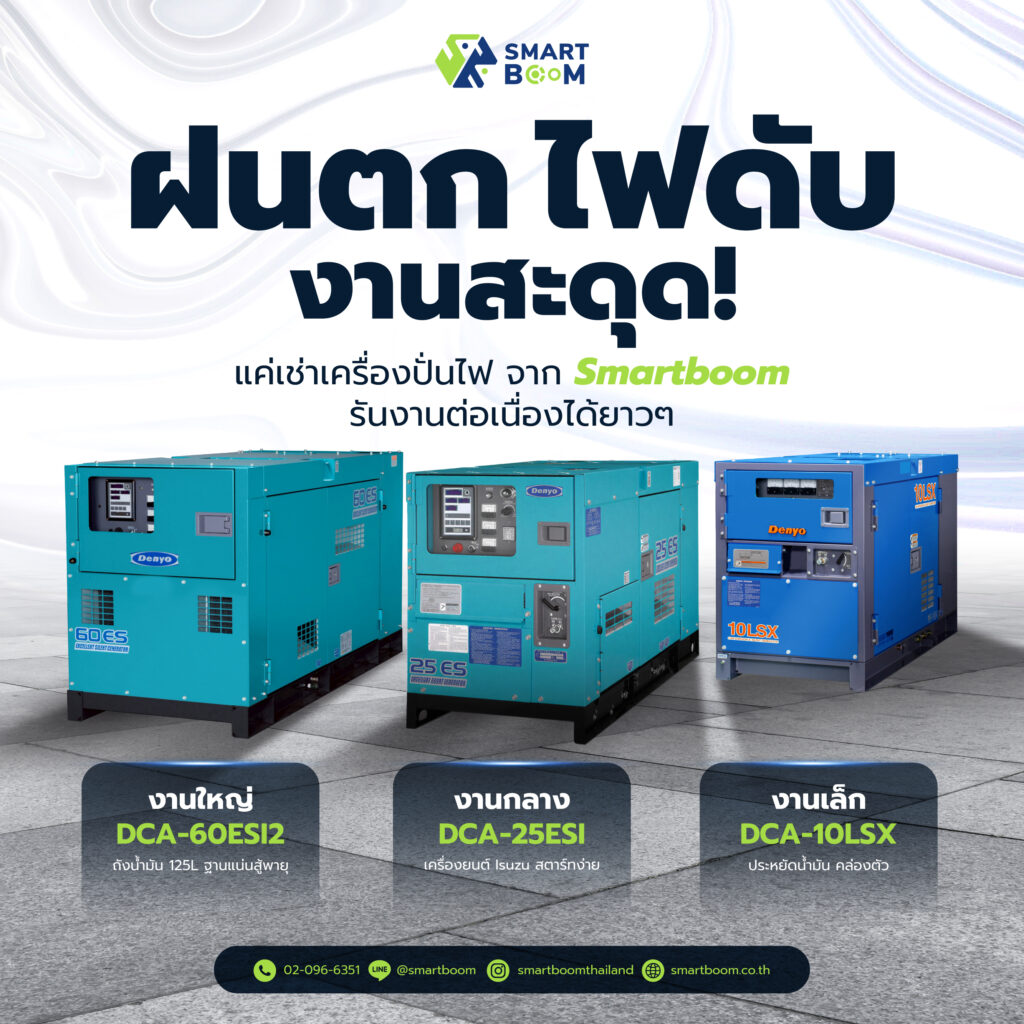
Technical Selection Guide: Selecting the Ideal Backup Generator for Rainy Conditions
Our rental fleet features high-performance Denyo (DCA Series) generators—premium, Japanese-standard, soundproof (Silent Type) units. Engineered with fully enclosed steel canopies and weather-resistant roofs, these units shield internal engines and alternators from driving rain. This industrial design stands in stark contrast to open-frame generators, which must never be exposed to moisture.
Here is how our fleet scales across varying project sizes:
1. Small-Scale Sites / Food Trucks / Mobile Retail (Optimized for Mobility)
-
Recommended Model: DCA-10LSX (10 kVA | 1-Phase, 2-Wire)
-
Strategic Fit: Powered by a compact, high-efficiency Kubota engine, this model combines a weather-secure, soundproof enclosure with exceptional fuel economy. Consuming just 2.9 L/h from a 62-liter fuel tank, it is the ideal choice for low-tonnage, budget-conscious operations requiring maximum agility.
2. Mid-Sized Construction Sites / Outdoor Events / Worker Camps
-
Recommended Model: DCA-25ESI (25 kVA | 3-Phase, 4-Wire)
-
Strategic Fit: Driven by a heavy-duty Isuzu engine, this unit is built for high-humidity ignition and prolonged operational runtimes. It burns just 4.2 L/h and features rain-impermeable cabinetry alongside advanced short-circuit protection. This allows field crews to operate drills, cutting stations, and high-intensity site lighting through heavy downpours with absolute electrical safety.
3. Industrial Facilities / Large Construction Infrastructure / 24-Hour Mission-Critical Power
-
Recommended Model: DCA-60ESI2 (60 kVA)
-
Strategic Fit: For mega-projects, a power failure exponentially compounds financial risk. This heavy-duty Isuzu-powered unit weighs 1,120 kg, providing a high-stability footprint that resists severe storm winds and prevents tipping. Equipped with an oversized 125-liter fuel tank, it supports extended overnight runtime. This eliminates the hazard of crews refueling in torrential rain, completely mitigating monsoon-related power risks.
Critical Safety Protocols: Operating Generators in Wet Conditions
While Denyo DCA Series generators feature robust weather-resistant engineering, maintaining rigorous site safety protocols during rain remains vital:
-
Mandatory Earth Grounding: Field technicians must properly install a grounding rod before commissioning the generator to eliminate electrical leakage risks from ambient moisture.
-
Protect Open-Frame Models: Portable, open-frame units—such as the GENPACK GP5SS (5 kVA)—lack protective canopies. They must be operated strictly under a shelter, awning, or temporary rain shed, and never exposed to direct rainfall.
-
Inspect Cable Connections: Prior to energizing the backup system, verify that all main distribution lines, cable couplers, and junctions are completely dry and clear of standing water.