
In heavy industries and large-scale enterprise operations, power stability is the ultimate benchmark for operational fluidness and site safety. Deploying sub-standard power infrastructure or mismatching a generator to your operational load introduces high mechanical risks, severe equipment downtime, and unmanageable cost overruns.
When it comes to global industrial power generation, Denyo stands as the premier, Japanese-engineered choice trusted by engineers worldwide. Below is an expert analysis of the three critical high-stakes job sites where Denyo’s advanced engineering is essential to secure peak operational efficiency.
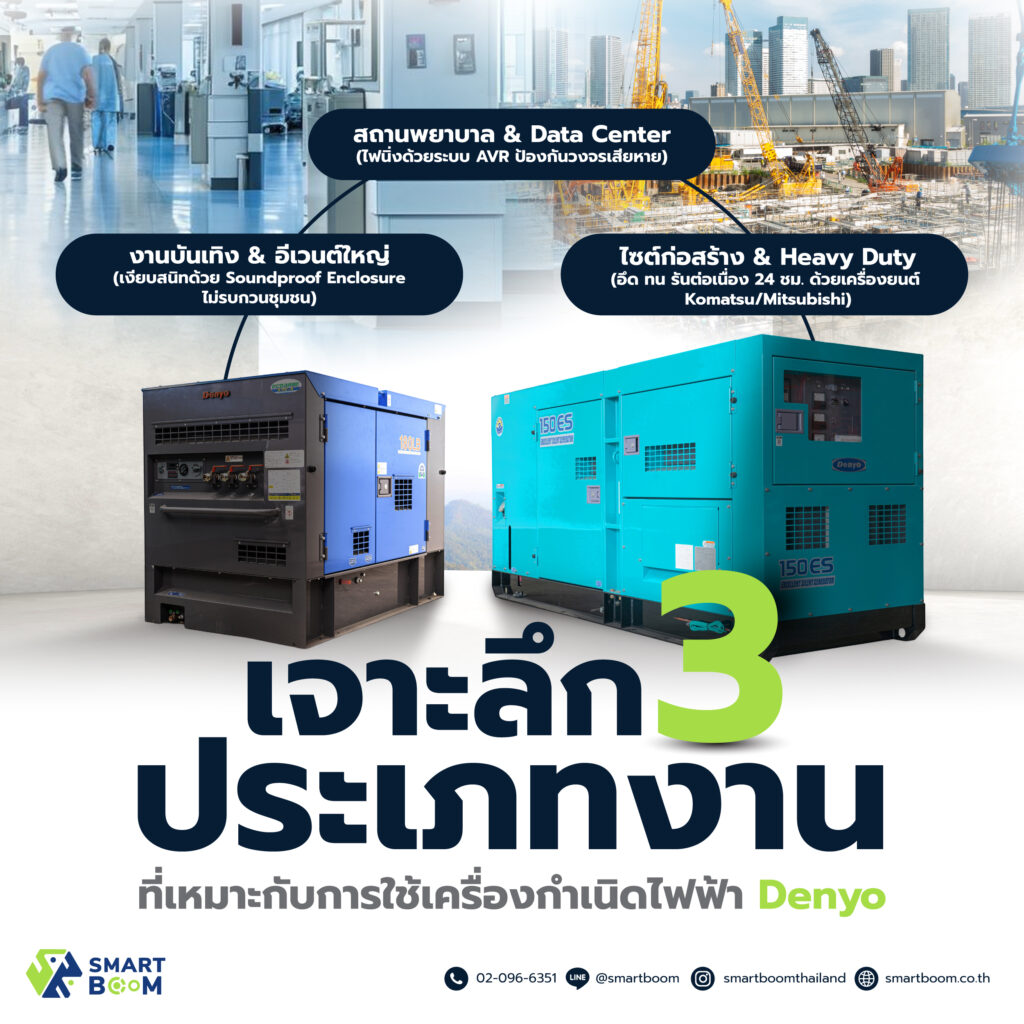
3 Critical Heavy-Duty Applications for Denyo Generators
1. Healthcare Facilities & Data Centers (Mission-Critical Power & Voltage Precision)
Operating rooms, intensive care units, and cloud data centers are zero-tolerance environments where a power fluctuation lasting even milliseconds can endanger lives or corrupt critical enterprise data. Furthermore, sophisticated medical equipment and server topologies are hypersensitive to power harmonics.
-
The Denyo Advantage: Engineered with proprietary Automatic Voltage Regulators (AVR) and precision frequency control microchip systems, Denyo generators output clean, stable, and pure sine wave electricity. This eliminates harmonic distortion, completely safeguarding multi-million dollar electronic components and medical instruments from power surges.
2. Entertainment, Broadcasting & Mega-Events (Acoustic Integrity & Ultra-Low Noise Innovation)
High-profile concert tours, feature film sets, and major commercial exhibitions often operate within dense urban cores or sound-sensitive environments where audio recording requires absolute acoustic silence.
-
The Denyo Advantage: Denyo is a pioneer in acoustic engineering, featuring specialized Soundproof Enclosures. These sound-attenuating canopies damp mechanical vibrations and absorb engine noise, enabling the genset to run at ultra-quiet levels. This ensures seamless compliance with strict municipal noise ordinances while maintaining clean audio captures on set.
3. Infrastructure & Heavy Construction (Rugged Endurance & Continuous 24/7 Power Runtimes)
Mega-projects—such as mass transit rail lines, highway expansions, tunneling, and remote industrial plants—frequently operate far beyond the reach of the primary electrical grid. These sites require heavy machinery and massive electric motors to grind through punishing environments filled with high temperatures and dense construction dust.
-
The Denyo Advantage: Built to rigorous Heavy-Duty standards, Denyo gensets are coupled with world-class industrial engines (such as Komatsu and Mitsubishi). Known for their low fuel burn and rugged thermal endurance, these units sustain continuous 24/7 duty cycles under peak loads, mitigating jobsite downtime risks.
The Procurement Checklist: 3 Steps to Calculate the Ideal kVA Capacity
Selecting a top-tier brand is only half the battle; optimizing your operational return on investment (ROI) requires calculating the exact kVA capacity your site demands. Specifying an under-sized generator triggers frequent overloads, thermal stress, and equipment failure. Conversely, renting an over-sized unit leads to fuel inefficiencies and unnecessary capital expenditures.
To ensure a balanced load profile, field engineers utilize this professional three-step evaluation process before mobilizing an asset:
Step 1: Analyze Electrical Load Characteristics
Classify all on-site equipment by load types. Inductive loads—such as water pumps, air compressors, and heavy electric motors—generate a starting inrush current that spikes 3 to 5 times higher than their running wattage. This demands a significantly higher temporary power threshold compared to stable resistive loads like lighting grids or heating elements.
Step 2: Integrate the Engineering Safety Factor
Running a generator at 100% capacity for extended periods degrades engine components and compromises fuel economy. Standard international engineering protocols dictate calculating the total combined load and adding a 20% to 30% Safety Factor. This positions the generator within its sweet spot—typically between 70% and 80% load capacity—optimizing fuel efficiency and mechanical longevity.
Step 3: Factoring Environmental De-rating
Extreme ambient temperatures, high humidity, and high altitudes directly impact internal combustion engines. Jobsites characterized by intense heat or restricted airflow must account for engine de-rating. Choosing a Denyo unit ensures superior cooling efficiency, though procurement teams may still scale up the baseline kilowatt ($kW$) configuration to compensate for thermal-induced performance drops.
Denyo Intelligent Systems: Proactive Fuel Optimization & Hazard Mitigation
True asset cost-efficiency is calculated across the total lifecycle of the machine, measured through fuel economy and component durability. Denyo solves these modern operational pain points through two core technological systems:
-
Smart Eco-Throttle Tech (Load-Sensing Automation): Standard industrial generators run at a fixed RPM regardless of demand, leading to excessive fuel consumption during low-load periods. Denyo’s intelligent Eco-Throttle system continuously reads electrical consumption in real-time, automatically adjusting engine speeds to match the exact power draw. This on-demand power management slashes site fuel expenditures by 20% to 30%.
-
Proactive Automatic Shutdown System: To eliminate catastrophic mechanical failure, Denyo units are integrated with real-time diagnostic sensors. If the module detects critical anomalies—such as low oil pressure, engine overheating, or voltage irregularities—it triggers an instant emergency shutdown. This preserves the core asset, facilitates Predictive Maintenance, and prevents sudden mid-shift power failures on your site.